
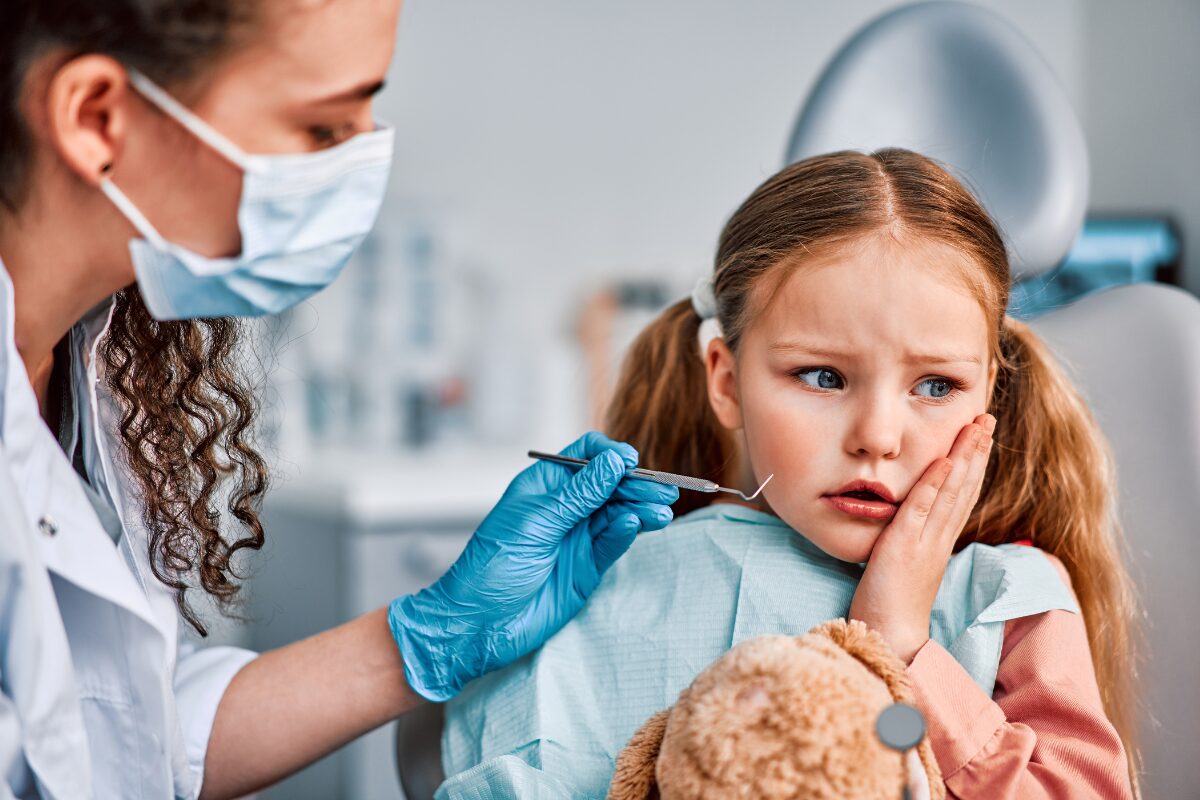
Your child just took a hit to the mouth, and there is blood, tears, and a tooth that looks wrong. You need to know what to do in the next few minutes. Here it is, plain and fast.
What to do right now
- For a knocked-out permanent tooth, act within 30 to 60 minutes. Pick it up by the crown, not the root, and put it back in the socket or in cold milk.
- Never push a knocked-out baby tooth back in. The American Academy of Pediatric Dentistry warns it can harm the adult tooth forming underneath.
- Go straight to the emergency room first for a possible head injury, a jaw that will not open, or bleeding you cannot stop.
- A toothache with swelling or fever is urgent. It can mean infection, which needs same-day care.
- Call Kids City Dental & Braces in Brighton at (720) 797-9779 and say the words “dental emergency” so the front desk fits you in.
Dr. Tory McFarlin and Dr. Thu McFarlin treat children only at Kids City Dental & Braces in Brighton, CO. Dr. Tory spent seven years treating pediatric patients before Brighton, and both are parents of two kids, so a panicked call about a bleeding mouth is familiar ground. The office also offers in-office general anesthesia, which matters for scared kids who need real repair work.
What actually counts as a dental emergency?
A dental emergency is any mouth injury or pain that needs care within hours, not days. Knocked-out permanent teeth, uncontrolled bleeding, facial swelling, and severe pain all qualify. Some problems can wait a day or two. The trick is telling the two apart fast, because a few of them are genuinely time-sensitive.
True emergencies share a pattern. There is trauma, spreading swelling, a tooth out of place, or pain that will not settle with basic care.
Kids get into these situations in predictable ways. Falls while learning to walk, playground spills, bike and scooter crashes, and elbows during sports account for most of what a pediatric dentist sees. Toddlers and grade-schoolers on wheels are the two big groups.
One quick note on baby teeth. Parents sometimes assume a baby tooth does not matter because it will fall out anyway. That is not quite right. A damaged baby tooth can still hurt, get infected, or affect the adult tooth underneath, so it earns the same call to the dentist that a permanent tooth would.
What is the most time-critical dental emergency?
A knocked-out permanent tooth is the most time-critical emergency, with a window of roughly 30 to 60 minutes. The living cells on the root start dying once the tooth dries out. The International Association of Dental Traumatology reports that reimplantation success drops sharply after 30 minutes and falls further past an hour. Fast, correct action decides whether the tooth survives.
Here is what to do in order, and the whole thing should take under five minutes.
First, stay calm and stop the bleeding with gauze or a clean cloth held over the socket for about 10 minutes. Your child reads your face, so a steady voice helps.
Second, find the tooth and pick it up by the crown, the white part. Do not touch the root.
Third, rinse it gently with milk or saliva if it is dirty. Skip tap water when you can, since it damages the root cells. Never scrub it.
Fourth, put a permanent tooth back in the socket the right way and have your child bite on gauze. If that is not possible, drop it in a cup of cold milk and bring it. For a baby tooth, do not reinsert it.
Baby tooth versus permanent tooth: how to tell
The difference decides your whole response, so check before you act. Baby teeth are smaller, whiter, and have short roots that often snap off. Permanent teeth are larger, a bit gray, and have a long root. If your child is under 6, it is almost surely a baby tooth. If you truly cannot tell, treat it as permanent and store it in milk, which never causes harm.
Baby teeth are never put back in the socket. The American Academy of Pediatric Dentistry is clear that replanting a baby tooth risks the permanent tooth developing beneath it. Store it in milk and bring it in anyway, so the dentist can check the socket and neighboring teeth.
Permanent teeth are the opposite. Speed and correct storage give the tooth its best chance, and every minute out of the mouth counts. If you get the tooth back in the socket or into milk within a few minutes, you have done the most important part before you even reach the office.
Which dental problems are urgent but not a race against the clock?
Some problems need same-day or next-day care, but not a frantic 30-minute dash. Chipped teeth, a bad toothache, a lost filling or crown, and a mouth cut that has stopped bleeding fit here. They still need a dentist, just not the exact-minute urgency of a knocked-out permanent tooth.
For a chipped or broken tooth, rinse the mouth with warm water and use a cold compress on the cheek to cut swelling. Save any pieces in milk or a wet cloth and bring them.
For a toothache, rinse with warm water and floss gently around the tooth to clear trapped food. Age-appropriate ibuprofen or acetaminophen can ease pain. Do not put aspirin on the gum, since it burns the tissue.
A toothache with facial swelling or fever moves up the list. That mix often points to infection, which a pediatric dentist should see the same day.
Problems that can safely wait for a regular appointment
A few things feel alarming but can wait for normal office hours. Mild sensitivity to cold, a tiny chip with no pain, a loose baby tooth that is ready to come out, and food stuck between teeth all fall here. Watch them, keep the area clean, and book a routine visit.
Sensitivity that comes and goes usually is not an emergency. Keep brushing gently and note when it happens, so you can describe it at the visit.
A loose baby tooth near its natural exit is normal. Let it wiggle free on its own, and skip pulling it early unless your dentist says otherwise.
Food caught between teeth can cause real pain, but it is not an emergency. Gentle flossing usually clears it. If the ache lingers after the food is out, that is worth a call, since steady pain can signal a cavity forming underneath.
When should you skip the dentist and go to the ER?
Go to the emergency room first when the injury is bigger than the teeth. Signs of a head injury, a broken or stuck jaw, deep facial cuts, or bleeding you cannot stop after 15 minutes all mean the hospital comes first, then the tooth. A child’s safety outranks any single tooth, every time.
Watch for vomiting, confusion, drowsiness, unequal pupils, or any loss of consciousness after a blow to the head. These need an emergency department, not a dental chair.
Once your child is medically stable, the dental care can follow. Bring any tooth or fragment with you, and note the time the injury happened.
The Brighton team can also guide you by phone while you decide. If you are not sure whether a fall counts as a head injury or a dental one, a quick call helps you sort it out before you drive anywhere.
Can you lower the odds of a dental emergency?
You cannot prevent every fall, but a few habits cut the risk a lot. A custom athletic mouthguard protects teeth during sports, car seats and seatbelts reduce facial injuries, and childproofing helps toddlers who are still finding their feet. None of these are foolproof, yet each one lowers how often a scary afternoon happens.
A mouthguard is the single biggest lever for active kids. A fitted guard cushions a blow that would otherwise chip or knock out a front tooth, and it costs far less than repairing one.
Teaching kids not to chew pencils, ice, or hard candy helps too. Cracked teeth often trace back to a habit rather than an accident. A quick word with your child about using teeth for chewing food only, not opening wrappers or bottle caps, goes a long way.
How to reach an emergency dentist in Brighton
The fastest path is one phone call. Call our dentists in Brighton at (720) 797-9779, say “dental emergency,” and describe what happened. The team can tell you whether to come in now, head to the ER first, or watch it at home.
Kids City Dental & Braces sits at 2331 Prairie Center Pkwy, Suite D, and serves families across Brighton and nearby towns like Commerce City, Thornton, and Henderson. The office keeps Wednesday hours until 7 PM, which helps when an after-school injury lands in the early evening.
Dr. Tory McFarlin and Dr. Thu McFarlin see only children, so your child is never squeezed between adult cases. For a frightened child who needs repair after a fall, the office offers in-office general anesthesia. When something goes wrong with your child’s teeth, call (720) 797-9779 and let the Brighton team walk you through the next step.