
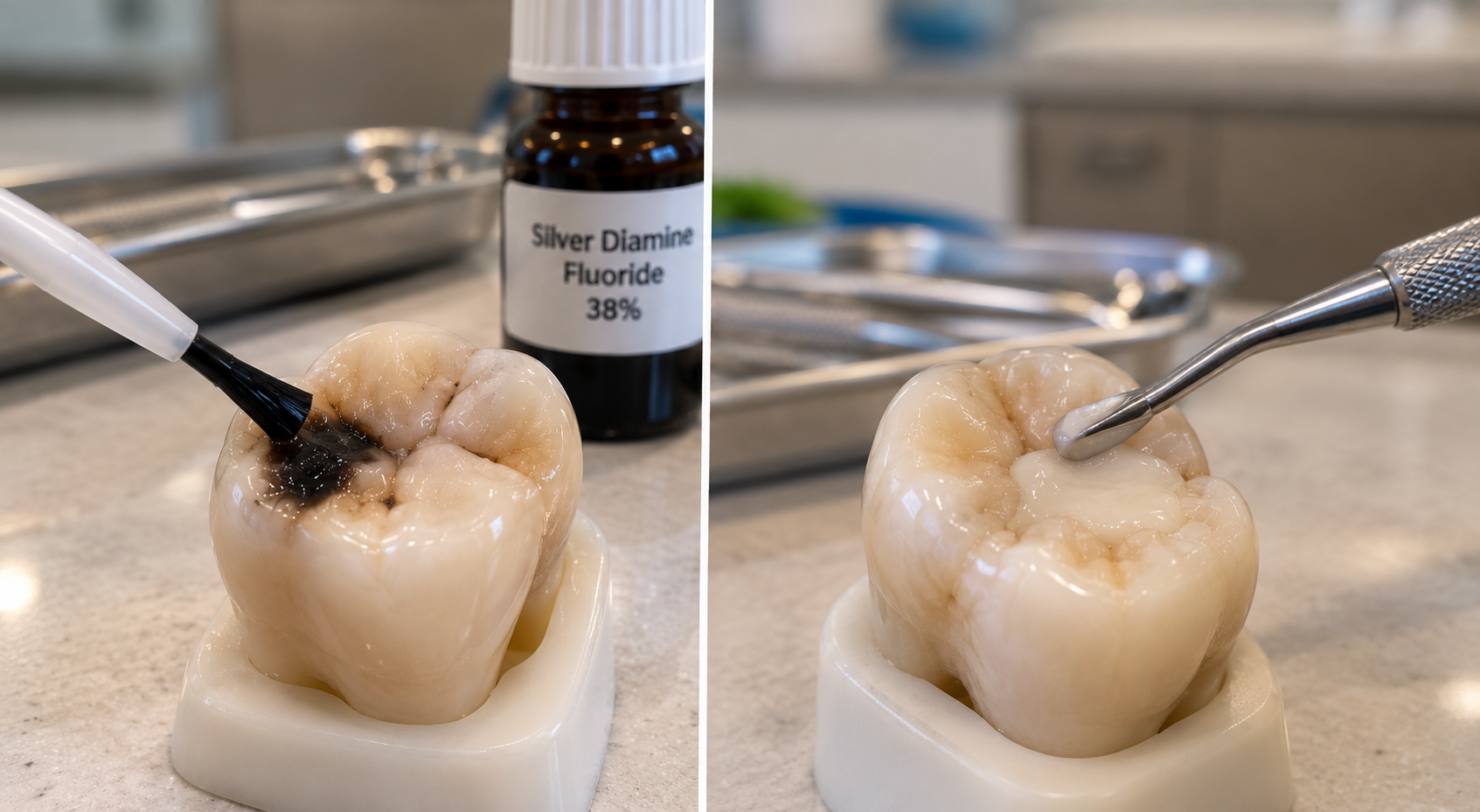
Your child has a cavity, and the dentist mentioned two very different fixes. One skips the drill but leaves a dark spot. The other drills and restores. Here is how to think it through.
The short answer for parents
- Silver diamine fluoride, or SDF, is a liquid brushed on a cavity to stop it from growing. No drill, no needle, about a minute per tooth.
- A filling removes the decay and rebuilds the tooth, so it closes the hole and restores chewing strength.
- SDF turns the treated cavity permanently black. That trade-off is the main reason some families still choose a filling.
- SDF suits young, anxious, or special-needs kids and small early cavities. Fillings suit larger cavities and visible front teeth.
- Neither is always better. The right call depends on the tooth, the cavity, and your child, and Kids City Dental & Braces in Brighton can help you decide.
Dr. Tory McFarlin and Dr. Thu McFarlin treat only children at Kids City Dental & Braces in Brighton, CO. As parents of two kids themselves, they know a cavity decision is rarely just about the tooth. It is about how your child handles the chair, what you can afford, and what the mouth needs long term.
Silver diamine fluoride, explained
Silver diamine fluoride is a liquid of silver and fluoride that a dentist brushes directly onto a cavity to halt decay. The silver kills the bacteria driving the cavity, and the fluoride hardens the softened tooth underneath. The American Academy of Pediatric Dentistry supports using 38 percent SDF to arrest cavities in baby teeth as part of a full care plan.
The appeal is simple. There is no drilling, no numbing shot, and the whole application takes about a minute per tooth.
SDF does not remove decay or fill the hole. It stops the existing cavity in place, leaving a harder, darker, inactive surface behind. The cavity is still there in shape, just no longer spreading.
That is why dentists describe SDF as interim stabilization, not a permanent repair. It buys time, calms a situation, and sometimes that is exactly what a young child needs. Used this way, as one step in a larger plan rather than the whole fix, it does a job no drill can do for a frightened two-year-old.
How do traditional fillings work?
A filling removes the decayed part of the tooth and replaces it with a durable material, restoring both the shape and the strength. The dentist numbs the area, clears the decay, and packs the space with tooth-colored composite. Unlike SDF, a filling closes the hole and lets the tooth chew normally again.
Fillings are the long-standing fix for a reason. They handle cavities that have grown too deep for SDF to control, and they rebuild a tooth that has lost real structure.
The trade-off is the experience. A filling usually needs local anesthesia, takes longer in the chair, and asks more patience from a young child. For an anxious kid, that can be a hard visit.
Modern fillings are tooth-colored, so the result blends in. For a visible front tooth, that cosmetic match is often the deciding factor.
A filling is also a one-and-done repair in most cases. Once the tooth is restored, it does not usually need the repeat visits that SDF can, since SDF often has to be reapplied to keep the decay in check. For a family that would rather settle a cavity in a single trip, that matters.
The real difference, side by side
The core difference is that SDF stops decay while a filling removes and rebuilds it. SDF is fast, painless, and cheap, but it stains the spot black and does not restore the tooth. A filling restores the tooth and matches its color, but it needs drilling, numbing, and more chair time. They answer different questions.
Here is the comparison dentists end up sketching for most parents.
| Feature | Silver diamine fluoride | Filling |
|---|---|---|
| The procedure | Brushed on, no drill or needle | Drilling, usually with numbing |
| Time in the chair | About a minute per tooth | Longer, one full appointment |
| Appearance | Turns the cavity permanently black | Tooth-colored, blends in |
| What it does | Stops decay, does not fill the hole | Removes decay and rebuilds the tooth |
| Best for | Small early cavities, young or anxious kids | Larger cavities, visible or permanent teeth |
| Relative cost | Lower | Higher, more so if sedation is needed |
The table makes the trade clear. SDF buys comfort and speed at the cost of appearance and permanence. A filling buys a full, matched repair at the cost of a harder visit.
One point is worth underlining, because it surprises parents most. SDF does not close the hole. The cavity’s shape stays, the decay simply stops. A filling is the opposite: it clears the decay and physically rebuilds what was lost. That single distinction drives most of the choices below.
When is silver diamine fluoride the better choice?
SDF tends to win when comfort and speed matter more than appearance. A toddler too young to sit through drilling, a child with real dental anxiety, a special-needs patient, or a small early cavity on a back baby tooth all point toward SDF. It also helps stabilize several cavities quickly while a longer plan comes together.
A back baby tooth is a common case. The black spot does not show, the tooth will fall out eventually, and the child skips a stressful procedure.
SDF can also serve as a bridge. It arrests the decay now and holds the line until a child is old enough, or calm enough, for a filling if one is still needed later.
Keep in mind that SDF usually needs reapplication to stay effective, and arrest rates, while good, are not 100 percent. Your dentist will want to recheck the tooth over time.
Cost can also tip the scale for some families. SDF is the least expensive way to treat active decay, and a quick visit keeps costs down further. For a family managing several small cavities on a tight budget, that difference adds up fast, and it buys room to plan the next step without pressure.
When is a filling the better choice?
A filling tends to win when the tooth needs real structure back or the spot is visible. A larger cavity, a front tooth where a black stain would show, or decay in a permanent tooth all lean toward a filling. When a child can handle the visit and the tooth needs lasting repair, a filling does more than SDF can.
Deep decay is the clearest case. Once a cavity has destroyed enough of the tooth that chewing is affected, only a restoration brings the structure back.
Visible teeth are the other big one. Many families accept a black spot on a hidden molar but not on a front tooth that shows in every photo and smile.
For a permanent tooth, dentists usually favor durable restoration, since that tooth has to last a lifetime rather than fall out on schedule.
Timing plays a role too. If a baby tooth still has years to go before it falls out naturally, a filling may protect it better over that stretch than SDF alone. A young molar that needs to chew through years of meals is a different situation from one about to wiggle loose.
Is silver diamine fluoride safe for kids?
SDF has a strong safety record in children, which is a big part of why it has become common. A dentist applies it in tiny amounts to the tooth surface, and the main documented downsides are the black staining and a brief metallic taste. The American Academy of Pediatric Dentistry includes it in its caries management guidance, including for young and special-needs patients.
The black stain is permanent on the treated decay, though it only marks the cavity itself, not the whole tooth. Parents should know this going in, since it cannot be polished off later.
Serious side effects are rare. A brief taste or a small temporary mark on the gum if it touches soft tissue are the usual extent, and both pass quickly.
Worth noting on the regulatory side: SDF is cleared in the United States as a treatment for tooth sensitivity, and its use to arrest cavities is considered off-label but widely accepted in pediatric dentistry. That is normal for many well-studied treatments, and the AAPD’s guidance reflects it. Your dentist will explain the staining and get your consent before applying it.
Making the decision for your child in Brighton
The best next step is an exam with a Pediatric Dentist in Brighton, CO,, since the right choice depends on the exact tooth and cavity. At Kids City Dental & Braces in Brighton, Dr. Tory McFarlin and Dr. Thu McFarlin look at the decay, your child’s age and comfort, and which tooth is involved, then lay out the honest trade-offs for your family.
The office sits at 2331 Prairie Center Pkwy, Suite D, and serves families across Brighton and nearby towns like Commerce City, Thornton, and Henderson. Wednesday hours run until 7 PM, which helps working parents fit a cavity visit into the day.
To talk through SDF, a filling, or whether your child even needs treatment yet, call Kids City Dental & Braces at (720) 797-9779. Dr. Tory McFarlin, Dr. Thu McFarlin, and the Brighton team can help you weigh comfort, cost, and long-term health, and pick the option that fits your child.